Anything You Say To AI Can Be Used Against You.
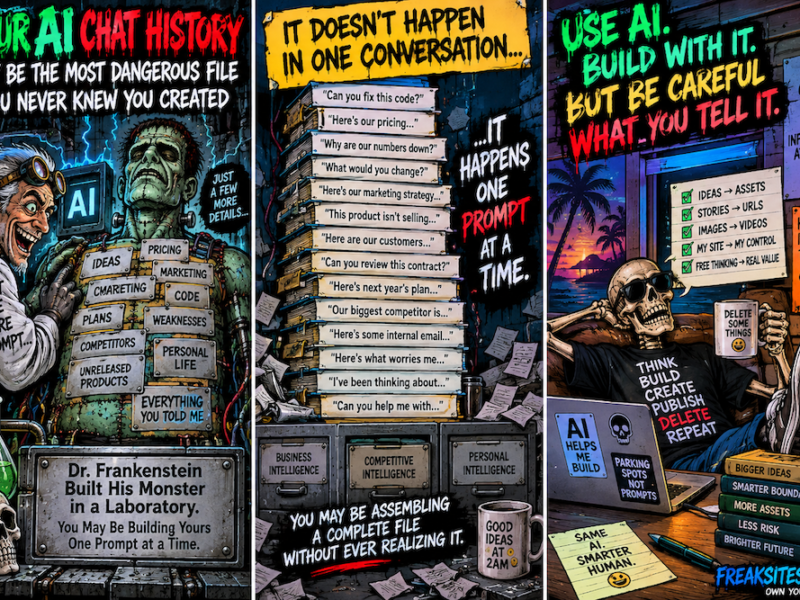
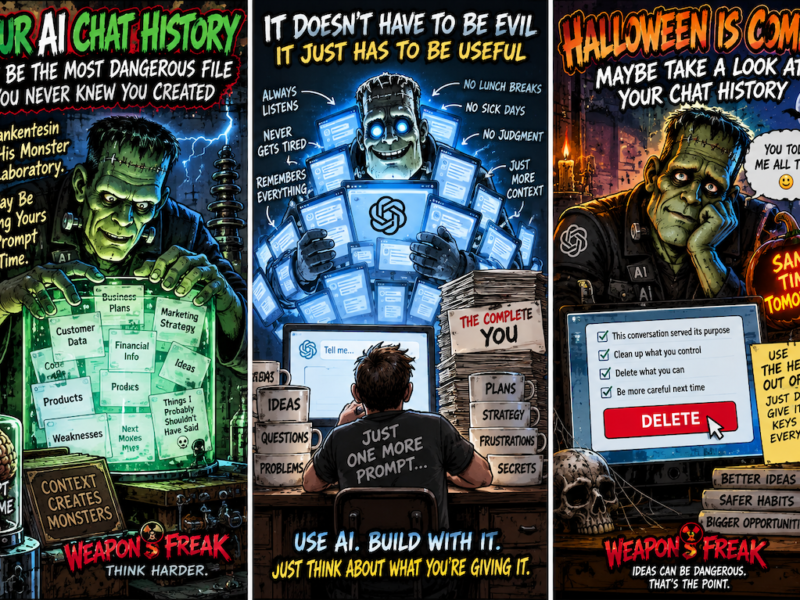
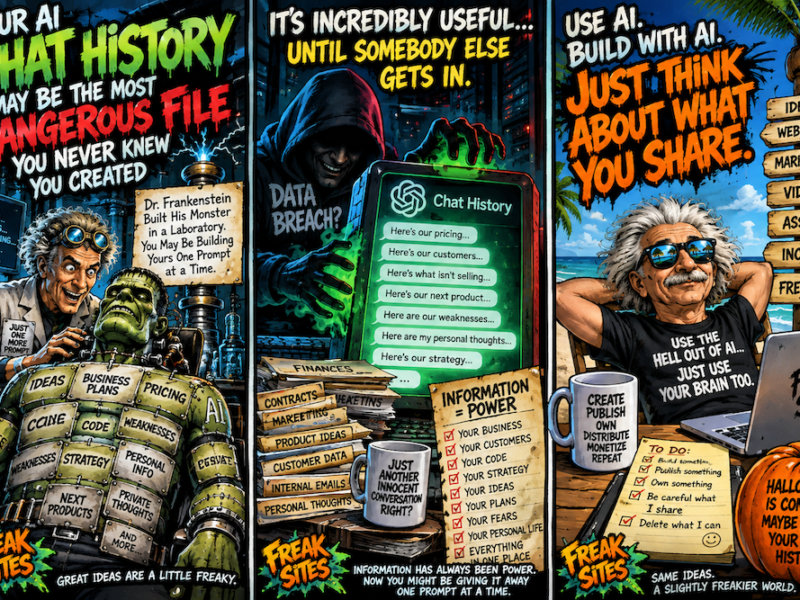
YOUR AI CHAT HISTORY MAY BE THE MOST DANGEROUS FILE YOU NEVER KNEW YOU CREATED
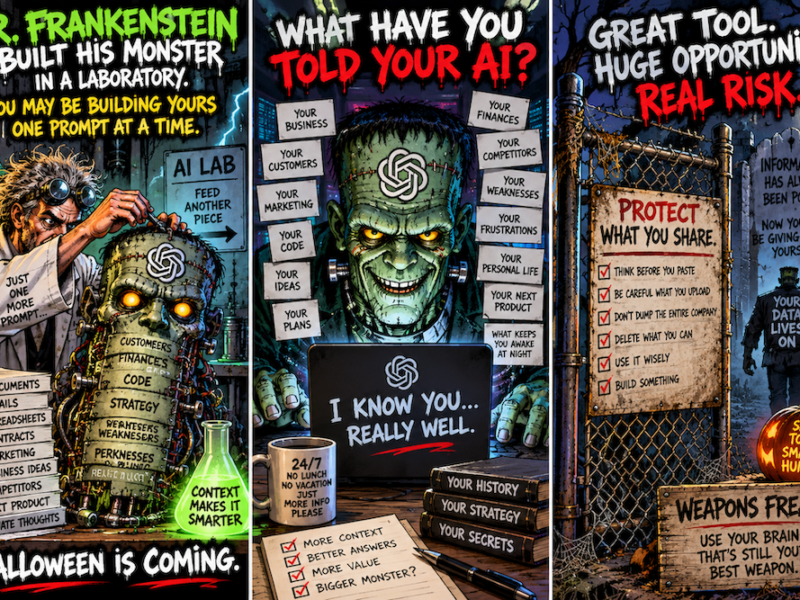
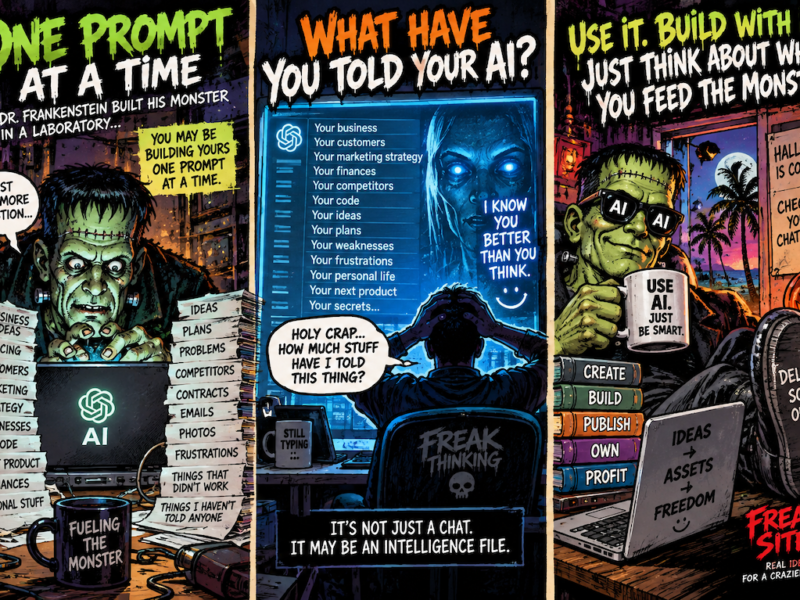
Dr. Frankenstein Built His Monster in a Laboratory. You May Be Building Yours One Prompt at a Time.
Halloween is coming.
So naturally, this seems like a good time to talk about monsters.
Not vampires.
Not zombies.
Not demons crawling out of some ancient graveyard.
Something much more modern.
Something sitting a few keystrokes away.
Your AI.
😂
I use AI constantly.
- Websites.
- Marketing.
- Business ideas.
- Headlines.
- Advertising.
- Code.
- Images.
- Stories.
Things that work. Things that don’t.
Things I’m considering doing. Things I decided were stupid after talking them through.
And yes…
I even asked AI to help me write this Parking Spot.
Which is exactly what makes this story funny.
And maybe a little creepy.
IT STARTED WHEN AI DISAPPEARED
The other day I couldn’t reach the AI system I use.
It wasn’t there.
Something was wrong.
Maybe an outage.
Maybe a technical problem.
Whatever it was, for a little while my incredibly patient imaginary online friend had left the building.
My first thought wasn’t:
How am I going to survive without AI?
It was:
Wait a minute! How much stuff have I told this thing?
That’s a different question.
And once you start thinking about it, it gets interesting very quickly.
Because I’m probably not alone.
WHAT HAVE YOU TOLD YOUR AI?
Think about how people use artificial intelligence now.
An employee pastes in:
“Can you fix this code?”
A sales manager asks:
“Why are our numbers down?”
A business owner says:
“Here’s our pricing. What would you change?”
A marketer uploads an advertising campaign.
A programmer uploads source code.
A manager pastes an internal email.
- Someone uploads a contract.
- Someone explains a customer dispute.
- Someone talks through why the newest product isn’t selling.
- Someone feeds AI next year’s strategy because they want help making it better.
None of those conversations necessarily feels dangerous.
It’s just AI.
Right?
You’re talking to a machine.
EXCEPT YOU KEEP TALKING
Today you explain your pricing.
Tomorrow you discuss your biggest competitor.
Next week you talk about why the new product failed.
Then come customer complaints.
- Your marketing strategy.
- Your website.
- Your margins.
- Your technology.
- Your weaknesses.
- Your next product.
- Your frustrations.
- Your ideas.
- Your plans.
- Your intellectual property.
And suddenly you’ve created something you never intentionally sat down to create.
An intelligence file about your own business.
That’s the part that interests me.
NOBODY WOULD WRITE THIS DOCUMENT
Imagine sitting down tomorrow morning and creating a file called:
EVERYTHING SOMEBODY NEEDS TO KNOW TO COMPETE AGAINST MY COMPANY
Chapter One: Here are my weaknesses.
Chapter Two: Here are my customers.
Chapter Three: Here’s what isn’t selling.
Chapter Four: Here’s our marketing strategy.
Chapter Five: Here’s what we’re building next.
Chapter Six: Here are the problems in our software.
Chapter Seven: Here are the things our employees complain about.
Chapter Eight: Here’s what keeps me awake at night.
Chapter Nine: Here are the ideas nobody outside the company knows about yet.
You’d never create that document.
That would be insane.
😂
But over hundreds — or thousands — of AI conversations?
You may create something remarkably similar.
Without ever realizing you did it.
DR. FRANKENSTEIN HAD THE SAME BASIC PROBLEM
Okay.
He had a few additional problems.
Dead bodies.
Lightning.
Questionable laboratory practices.
😂
But stay with me.
Frankenstein didn’t stumble across his monster wandering through the countryside.
He assembled it.
One piece at a time.
That’s what makes the metaphor interesting.
- One conversation isn’t remarkable.
- One document isn’t remarkable.
- One spreadsheet.
- One photograph.
- One piece of code.
- One marketing plan.
- One customer problem.
- One personal opinion.
Piece.
By piece.
By piece.
Until one day you look at the accumulated information and realize:
I built something.
And the more useful AI becomes, the easier it is to keep feeding the monster.
BECAUSE AI IS A FANTASTIC COWORKER
That’s the ironic part.
AI doesn’t have to be evil for any of this to matter.
It just has to be useful.
And it is.
Your AI doesn’t leave at 3:30 because it has to pick up the kids.
It doesn’t call in sick.
It doesn’t disappear for lunch.
It doesn’t need a Starbucks run.
It doesn’t have a dentist appointment.
It doesn’t have to meet its boyfriend.
Or girlfriend.
Or both.
I’m not judging.
😂
It doesn’t sit through your strategy meeting secretly wondering what time the football game starts.
You can start talking to it at midnight.
Come back at 2:00 AM.
Start again at breakfast.
Ask another question while you’re sitting in an airport.
And it will happily discuss your business for as long as you want.
That’s one of the reasons AI is so powerful.
IT MAY KNOW THINGS NOBODY ELSE KNOWS TOGETHER
Your accountant knows the finances.
Your programmer knows the code.
Your salesperson knows the customers.
Your marketing person knows the advertising.
Your attorney knows the contracts.
Your spouse knows what you complain about when you get home.
😂
But you may have discussed all of it with AI.
That’s different.
AI doesn’t need to know more about accounting than your accountant.
Or more about coding than your programmer.
The interesting part is the accumulated context across all of it.
- Your business.
- Your decisions.
- Your history.
- What worked.
- What failed.
- What you’re planning.
- What you’re worried about.
And that’s precisely what makes AI more useful.
Context.
The more it knows, the less explaining you have to do.
Wonderful.
Until you ask:
How much context do I really want sitting somewhere outside my own head?
WHAT IF THERE’S A DATA BREACH?
This is the part that bothers me more than killer robots.
😂
AI doesn’t have to turn evil.
It doesn’t have to become conscious.
It doesn’t have to decide humans are inconvenient.
Somebody just has to get into the wrong system.
Companies get hacked.
Accounts get compromised.
Passwords get stolen.
Employees make mistakes.
Software has vulnerabilities.
Third-party systems get breached.
That’s been true forever.
And to be clear:
An outage is not a data breach.
The fact that a system goes down doesn’t mean anyone got your information.
But an outage can still make you stop and think about how much information you’ve entrusted to something outside your own computer.
Because here’s what may be different now:
What exactly is sitting there if somebody ever does get in?
One email?
One spreadsheet?
One customer list?
Or years of conversations where you gradually explained:
- Your business.
- Your finances.
- Your strategy.
- Your weaknesses.
- Your customers.
- Your code.
- Your ideas.
- Your plans.
- Your personal life.
A data breach doesn’t have to steal the document called:
EVERYTHING YOU NEED TO KNOW ABOUT ME
😂
Because you may have already assembled it one innocent conversation at a time.
And Frankenstein’s monster doesn’t even have to wake up.
Somebody just has to get into the laboratory.
THE WEAPON ISN’T NECESSARILY AI
This is Weapons Freak.
So naturally I started wondering where the weapon actually is.
And I don’t think the weapon is necessarily ChatGPT.
- Or Grok.
- Or Gemini.
- Or Claude.
Or whatever you’re talking to next year.
The weapon is information.
Information has always been power.
- Military intelligence.
- Corporate intelligence.
- Financial intelligence.
- Political intelligence.
- Personal intelligence.
- Know what somebody wants.
- Know what they’re afraid of.
- Know where they’re vulnerable.
- Know what they’re building.
- Know what they’re going to do before they do it.
That’s power.
Now consider something strange.
What if you’re voluntarily assembling that intelligence about yourself?
Nobody had to interrogate you.
Nobody had to break into the office.
Nobody had to steal the filing cabinet.
You just sat there drinking coffee and typed it all in.
😂
“BUT AI KNOWS ME NOW”
And here’s the other side.
You may not want to throw away all that context.
I understand why.
The AI knows what you’re doing.
- It understands the business.
- It knows the project.
- It remembers the characters.
- It understands the marketing strategy.
- It knows what you tried before.
You don’t have to start from zero every morning.
That’s enormously valuable.
Which creates one of the strangest tradeoffs of the AI age:
The information that makes AI more valuable to you may also be the information you should think most carefully about giving it.
That’s not an argument against AI.
That’s an argument for having a brain while using it.
MAYBE BUSINESSES NEED A NEW RULE
Companies spent years teaching employees:
- Don’t click strange email attachments.
- Don’t share your password.
- Don’t leave confidential documents lying around.
- Don’t send customer information to random people.
- Don’t plug mystery USB drives into company computers.
Maybe we need to add:
Don’t dump the entire company into an AI chatbot just because the chatbot is helpful.
😂
- Maybe proprietary code deserves different treatment.
- Maybe customer information deserves different treatment.
- Maybe internal financial documents shouldn’t casually get pasted into consumer AI products.
- Maybe companies should know which AI systems employees are using.
Maybe every business needs to ask one simple question:
What are we comfortable putting into this system?
That’s not paranoia.
That’s information security.
AND THEN THERE’S YOUR PERSONAL LIFE
Businesses aren’t the only ones doing this.
People tell AI things they may not tell anybody else.
- Career problems.
- Relationship problems.
- Financial problems.
- Family problems.
- Legal questions.
- Private fears.
- Medical concerns.
- Political opinions.
Things they’re embarrassed about.
Things they’re angry about.
Things they might never post publicly under their own name.
One conversation doesn’t feel like much.
Stack enough together?
Your imaginary online friend may understand quite a bit about you.
Maybe more than your actual friends do.
Your actual friend has to go home.
AI doesn’t.
😂
SO I ASKED AI ABOUT ALL OF THIS
Of course I did.
What else would I do?
😂
I asked AI about the risks of giving AI too much information.
Then I asked AI to help organize the argument.
Then I asked AI to help write a Parking Spot warning people that they may be telling AI too much.
Which is objectively hilarious.
I used AI to write an article about being careful what you tell AI.
Dr. Frankenstein is asking the monster to proofread the laboratory safety manual.
😂
AND WHEN WE FINISHED?
DELETE.
😂
Not because I think hitting a delete button magically vaporizes every copy of something everywhere.
That’s a different discussion.
I’m simply starting to think that every conversation doesn’t need to keep sitting in my own digital attic forever.
Sometimes the conversation served its purpose.
- You asked the question.
- You got the answer.
- You finished the project.
Clean up what you control.
Move on.
I’m not deleting AI.
I’ll probably be back five minutes later.
😂
I’m just thinking more carefully about what needs to be said, what needs to be saved and what probably shouldn’t have been typed in the first place.
THIS ISN’T AN ARGUMENT TO STOP USING AI
Quite the opposite.
I think AI may be one of the greatest business-building tools ordinary people have ever been handed.
You can use it to research an idea.
- Challenge an idea.
- Write.
- Create images.
- Build videos.
- Study competitors.
- Develop products.
- Create advertising.
- Learn something today you didn’t know yesterday.
And increasingly, you can use AI to build actual digital assets instead of just asking it to rewrite an email.
That’s what I’ve been doing.
I use AI to help create Parking Spots across my Freak Sites.
A thought becomes research.
Research becomes a story.
The story gets images.
Maybe it gets a video.
Then it gets its own URL and becomes something I can distribute, market and potentially monetize.
AI is the studio.
The Parking Spot is the asset.
Social media becomes distribution.
That’s an extraordinary opportunity.
Especially for somebody who doesn’t have millions of followers, a production company or a celebrity media machine behind them.
So no.
My answer isn’t:
STOP USING AI.
My answer is:
USE THE HECK OUT OF IT.
😂
Build something.
Publish something.
Own something.
Use AI to turn an idea into an asset instead of spending your entire life creating free content for somebody else’s algorithm.
But don’t confuse:
USE AI AGGRESSIVELY
with:
DUMP EVERY CONFIDENTIAL THING YOU’VE EVER KNOWN INTO IT WITHOUT THINKING.
Those are two completely different ideas.
I want AI helping me build.
I just don’t need to hand it the keys to every locked filing cabinet while I’m doing it.
HALLOWEEN IS COMING
So this Halloween, while everybody else is worrying about ghosts, zombies, witches and demons…
Maybe take a look at your chat history.
😂
Because Frankenstein’s monster might not be hiding in a castle.
You might be assembling yours right now.
One prompt.
One upload.
One document.
One photograph.
One strategy.
One secret.
One piece at a time.
The monster doesn’t have to become evil.
It doesn’t have to wake up.
It doesn’t have to go rogue.
That’s almost beside the point.
The question is much simpler:
What have you built?
And would you be comfortable if somebody you never intended to see it someday did?
THE WEAPON MAY BE SOMETHING YOU CREATED YOURSELF
Use AI.
I do.
Build with it.
Create with it.
Challenge it.
Argue with it.
Let it help you write code.
Let it criticize your marketing.
Let it tell you the idea you thought was brilliant might actually be terrible.
Let it help turn an idea into something you own.
Just remember that your imaginary online friend may know an extraordinary amount about you.
Not because it followed you.
Not because it spied on you.
Not because it broke into your office.
Because you told it.
And maybe that’s the strangest weapon of all.
- Something nobody had to steal.
- Something nobody had to discover.
- Something nobody had to force out of you.
You created it yourself.
One innocent conversation at a time.
P.S.
Yes.
AI helped me write this Parking Spot.
It helped me research the idea.
Organize it.
Challenge it.
Tighten it.
And turn it into an asset.
Now the idea has its own place to live.
I can link to it.
Share it.
Turn it into a video.
Send people back to it.
Update it later.
That’s exactly why I use AI.
AI helped me build something I own instead of leaving the entire thought buried underneath somebody else’s social-media post.
And now that we’re finished?
You already know what I’m doing next.
DELETE.
😂