
THEY SAY AI IS COMING FOR YOUR JOB. WHAT IF IT'S COMING FOR THEIR MOAT

So who really wants the speed limit? And Why?
The people building, funding and controlling some of the most powerful technology in history keep warning us that artificial intelligence could take our jobs, destabilize society and maybe eventually become dangerous enough to threaten humanity.
Maybe they’re right.
Seriously.
Maybe AI really is that dangerous.
But I’ve got another question.
WHAT IF THEY’RE ALSO AFRAID OF WHAT HAPPENS WHEN EVERYBODY ELSE GETS TO USE IT?
That’s a slightly different conversation.
And apparently we’re supposed to be too busy worrying about losing our jobs to have it.
Bill Gates has warned that AI could substitute for human cognition across huge parts of the economy and that many jobs may disappear permanently.
He’s also called for national and international systems to manage the transition.
— Bill Gates, Gates Notes, 2026
Elon Musk signed the famous 2023 letter calling for a six-month pause in training AI systems more powerful than GPT-4.
— Future of Life Institute, 2023
OpenAI CEO Sam Altman went to Washington and told Congress that increasingly powerful AI systems needed government oversight.
— U.S. Senate Judiciary Committee, 2023
Anthropic CEO Dario Amodei warned Congress that advanced AI systems without appropriate safeguards could create catastrophic or even existential risks.
— U.S. Senate Judiciary Committee, 2023
So apparently everybody building the rocket wants to talk about installing speed limits.
Fair enough.
Rockets can crash.
But before we hand somebody the keys to the tollbooth, maybe we’re allowed to ask who gets to use the highway.
BILL SAYS AI COULD TAKE MY JOB
Okay.
Really?
Which one?
Because I’m sitting here using AI to build companies I couldn’t have built by myself.
I don’t code.
I’m not an English major.
I don’t have a software-development department.
I don’t have an advertising agency.
I don’t have a research staff.
I don’t have a graphic-design department.
I don’t have a newsroom.
I don’t have 200 employees sitting around a conference table discussing the Q4 strategic vision for my website.
Thank God.
😂
Yet with artificial intelligence helping me, I can:
- Build websites
- Troubleshoot code
- Develop products
- Research stories
- Create graphics
- Produce videos
- Write marketing campaigns
- Analyze business ideas
- Work through technical problems
- Build systems I didn’t know how to build yesterday
AI hasn’t fired me.
IT KEEPS SHOWING UP FOR WORK.
That’s a little different.
And here’s where this gets funny.
Bill Gates himself wrote about AI agents and said that someday you won’t need to know how to write code or even do graphic design to create a new app or service.
You’d simply tell the AI what you wanted.
— Bill Gates, Gates Notes, “AI-powered agents are the future of computing”
Wait a minute.
Isn’t that basically what I’m doing?
😂
I don’t know how to code the thing.
But I know what I want the thing to do.
Those are not the same skill.
And they aren’t remotely the same economic model.
AI DIDN’T TAKE MY JOB.
AI GAVE ME CAPABILITIES I COULDN’T AFFORD BEFORE.
That’s the part of this story that deserves a lot more attention.
And apparently I’m not the only one.
OECD research found that among small and medium-sized businesses already using generative AI:
- 65% said it improved employee performance.
- 35% said it helped them scale.
- 29% said it helped them compete with larger companies.
- 26% said it helped increase revenue.
— OECD, Generative AI and the SME Workforce
Hold on.
29% SAID IT HELPED THEM COMPETE WITH LARGER COMPANIES.
Well…
Now we’re getting somewhere.
MAYBE THE JOB ISN’T THE ONLY THING AT RISK
Imagine two companies.
Company A has:
- 500 employees
- Programmers
- Designers
- Lawyers
- Writers
- Researchers
- Marketing people
- Managers
- Office buildings
- Millions of dollars in overhead
Company B has:
- One guy
- A laptop
- A phone
- ChatGPT
- Football on one television
- Baseball on another
- X open during the commercials
😂
Twenty years ago, Company B probably wasn’t keeping Company A awake at night.
Today?
Maybe it should.
Not because the guy sitting on the couch suddenly became smarter than everybody inside Company A.
Not because ChatGPT magically turned him into Bill Gates.
Because suddenly he has something he didn’t have before.
LEVERAGE.
He can attempt things that previously required money, employees and specialized expertise.
That matters.
The traditional scary AI story goes something like this:
AI replaces the little guy.
Okay.
Maybe.
But there’s another possible story.
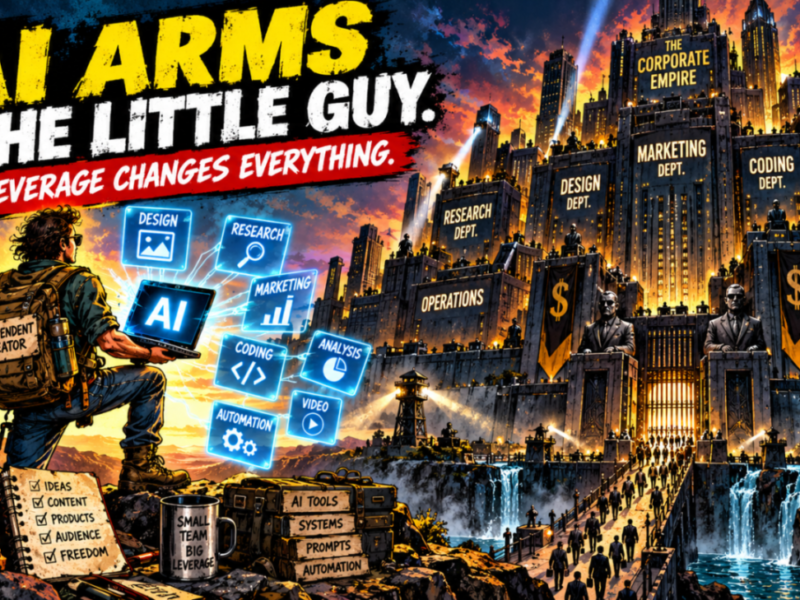
AI ARMS THE LITTLE GUY.
Now we’re on Weapons Freak.
Words are weapons.
Technology is a weapon.
Information is a weapon.
Leverage is a weapon.
And suddenly a whole lot more people have access to one.
AI ISN’T GOING TO BUY MY PARKING SPOT
This is where the whole “AI replaces everybody” argument starts getting a little strange to me.
AI can help me build a product.
- It can help me explain the product.
- It can help me improve the website.
- It can help me make the graphics.
- It can help me troubleshoot the code.
- It can even tell me when my idea is stupid.
Sometimes.
😂
But AI isn’t going to buy my Parking Spot.
- AI isn’t going to tell seven people about it.
- AI isn’t going to get those seven people excited enough to tell seven more.
- AI isn’t going to build the human relationships.
- AI isn’t going to take the business risk.
- AI isn’t going to pay the hosting bill.
- AI isn’t going to decide what company I build next.
And apparently AI isn’t going to sit up until midnight wondering why a WordPress plugin that worked perfectly two hours ago suddenly decided it didn’t feel like working anymore.
That’s still my job.
😂
NOW THE GATEKEEPING QUESTION GETS INTERESTING
Let’s be clear about something.
There are legitimate AI risks.
- Fraud
- Cyberattacks
- Privacy
- Biological misuse
- Autonomous systems
- Manipulation
- Security threats
Those aren’t imaginary.
Powerful technologies create powerful consequences.
But here’s another thing that isn’t imaginary:
REGULATION IS NOT EQUALLY EXPENSIVE FOR EVERYBODY.
- Microsoft can hire another compliance department.
- Google can hire another 200 lawyers.
- Amazon can probably build a compliance building.
The guy working from his kitchen table?
Great news.
He can hire a regulatory-compliance department with all the money he doesn’t have.
😂
Imagine advanced AI eventually requires:
- Expensive government certification
- Specialized audits
- Licensing
- Mandatory insurance
- Expensive testing
- Specialized attorneys
- Detailed reporting systems
- Approved computing infrastructure
Who survives that most easily?
- Microsoft?
- Google?
- Amazon?
- OpenAI?
- Anthropic?
Probably.
- What about the next great company that hasn’t been invented yet?
- What about two people in Wisconsin?
- What about a kid in Albuquerque?
- What about somebody who can’t afford twenty engineers but has an idea nobody at Microsoft thought of?
That’s where the conversation gets more interesting.
AND THE AI BUSINESS IS ALREADY A PRETTY EXPENSIVE CLUB
The Federal Trade Commission has already examined the enormous partnerships connecting major cloud companies and major AI developers.
- Microsoft and OpenAI.
- Amazon and Anthropic.
- Google and Anthropic.
The FTC found billions of dollars in investment, cloud-computing commitments, access to scarce computing resources, technical information and other arrangements that could affect competition and the ability of new AI companies to get critical resources.
— Federal Trade Commission, report on large AI partnerships and investments
That doesn’t mean somebody is sitting in a secret underground conference room plotting the destruction of the little guy.
They don’t need to be.
The economics work perfectly well without the secret underground conference room.
AI already requires enormous amounts of:
- Money
- Chips
- Electricity
- Data
- Cloud computing
- Engineering talent
Now put a gigantic compliance structure on top of that.
Who has the easiest time paying for it?
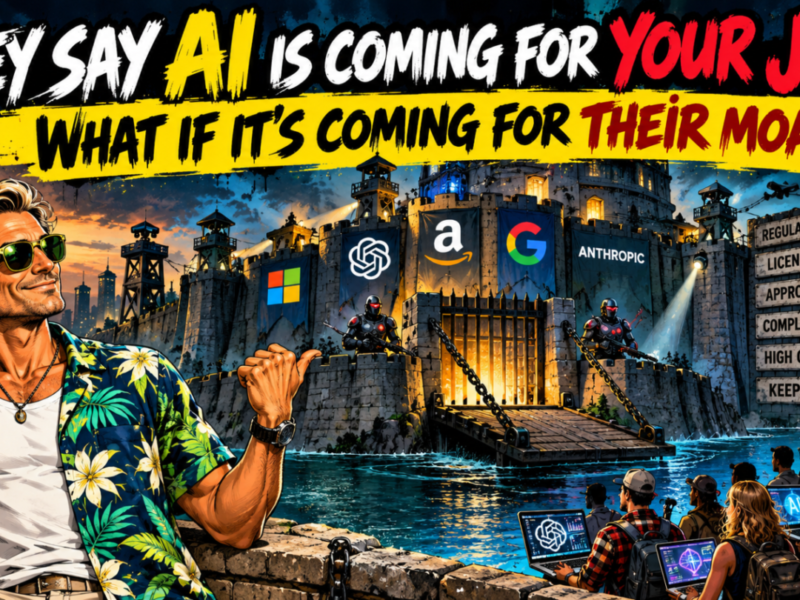
The companies already inside the castle.
Again, that doesn’t prove sinister intent.
It simply raises a very reasonable question:
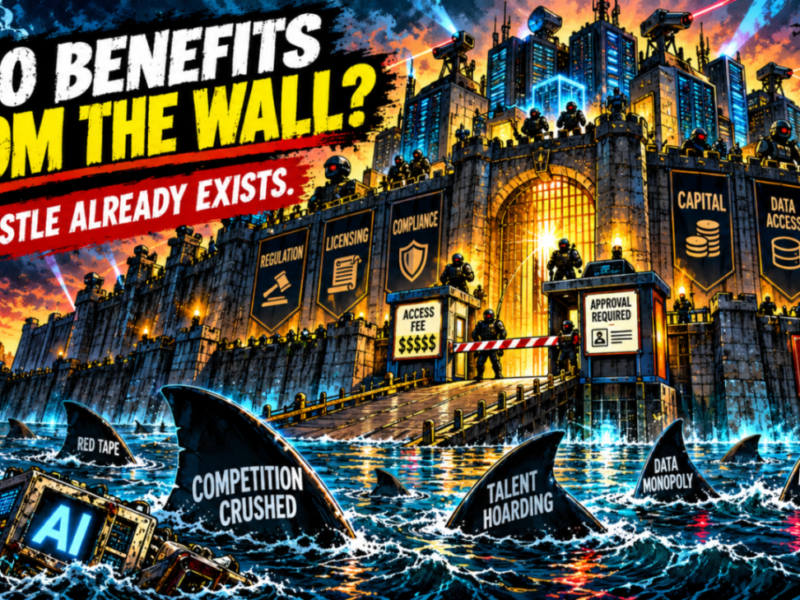
WHO BENEFITS FROM THE WALL?
WE’VE SEEN THIS MOVIE BEFORE
Not with artificial intelligence.
With the Internet.
When ordinary people suddenly gained access to a communications system that could reach the entire world, governments immediately ran into legitimate problems.
- Crime.
- Pornography.
- Copyright infringement.
- Encryption.
- Children’s safety.
- National security.
There were real issues.
And then came the proposed solutions.
THE CLIPPER CHIP
Back in the 1990s, the U.S. government promoted something called the Clipper Chip.
The basic concept was strong encryption…
…with a government-access mechanism built into the system.
You know.
Private.
Except when somebody with the key decided it wasn’t.
For safety.
The government argued that law enforcement and national security required access to encrypted communications.
Privacy advocates and technologists responded with what could roughly be summarized as:
“Yeah. No.”
The proposal never became the dominant encryption system.
— Electronic Frontier Foundation archive on Clipper and key escrow
THEN CAME THE COMMUNICATIONS DECENCY ACT
Protect children from harmful Internet content.
Sounds reasonable.
Who wants to argue against protecting children?
That’s a pretty good sales pitch.
The problem was that major portions of the law criminalized broad categories of online speech considered “indecent” or “patently offensive.”
The Supreme Court struck those provisions down in 1997 as an unconstitutional restriction on speech. — Reno v. ACLU, U.S. Supreme Court, 1997
And one of the revolutionary things about the Internet was exactly what made it so disruptive:
THE LITTLE GUY COULD PUBLISH TOO.
- You didn’t need to own NBC.
- You didn’t need a newspaper.
- You didn’t need a printing press.
- You didn’t need permission from a publisher.
- You needed a computer and an Internet connection.
Suddenly everybody had a printing press.
That changed everything.
THEN CAME SOPA AND PIPA
The problem?
Internet piracy.
Again:
A real problem.
The proposed cure?
Critics argued that the enforcement system could interfere with legitimate websites and damage the open architecture of the Internet.
Wikipedia, Reddit and thousands of other sites protested.
The bills went nowhere.
Notice something?
The underlying problem doesn’t have to be fake.
The danger doesn’t have to be imaginary.
The people proposing the solution don’t even have to be evil.
The question is still:
- How much control are we creating?
- Who gets that control?
- Who can afford to comply?
- Who gets locked out?
- Who becomes the gatekeeper?
Those questions were important for the Internet.
They’re important for AI too.
WORDS ARE WEAPONS
Which brings us back to the sales pitch.
Listen to the words:
AI will take your job.
AI could become uncontrollable.
AI could create catastrophic weapons.
AI could manipulate humanity.
AI could destroy entire industries.
AI could threaten civilization.
Maybe.
Some of those dangers deserve serious attention.
But words do something.
Fear changes what people will agree to.
If people become convinced that a technology represents an existential threat, suddenly all kinds of controls start sounding perfectly reasonable.
- Licensing
- Monitoring
- Government approval
- International oversight
- Limits on computing power
- Limits on models
- Limits on deployment
- Limits on who gets access
Maybe some of those controls will be necessary.
But every single one should come with another question.
WHO GETS LOCKED OUT?
Because there’s a huge difference between:
Don’t let somebody use AI to design a biological weapon.
and:
Only enormous approved institutions should have access to extremely capable AI.
Those are not remotely the same thing.
WHAT IF AI DOESN’T DESTROY CAPITALISM?
WHAT IF IT DEMOCRATIZES IT?
That’s the question I don’t hear nearly enough.
For most of modern business history, money bought capability.
Want software?
Hire programmers.
Want advertising?
Hire an agency.
Want professional writing?
Hire writers.
Want research?
Hire analysts.
Want graphics?
Hire designers.
Want sophisticated data analysis?
Hire specialists.
Want to launch a technology company?
- Raise money.
- Hire engineers.
- Build departments.
Then AI showed up.
Suddenly the equation started changing.
- Money still matters.
- Human expertise still matters.
- Experience still matters.
- Judgment still matters.
- Relationships still matter.
But the cost of accessing useful capability dropped dramatically.
And when the price of capability drops…
MORE PEOPLE GET TO PLAY.
Maybe the real economic fight isn’t:
Humans versus robots.
Maybe it’s:
INCUMBENTS VERSUS EVERYBODY WHO JUST GOT A POWER TOOL.
THE HORSE AND THE CAR
Imagine it’s 1905. You own the greatest horse empire in America.
- Thousands of horses.
- Stables.
- Feed suppliers.
- Carriage factories.
- Drivers.
- Blacksmiths.
- Veterinarians.
- Real estate.
- Distribution.
- Political relationships.
Then some lunatic drives up in an automobile.
Naturally, your first concern is public safety.
These automobiles are dangerous.
They’re fast. They’re noisy.
Somebody could get hurt.
Clearly we need:
- Licenses
- Permits
- Inspections
- Speed restrictions
- Special roads
And perhaps only established horse companies should be allowed to manufacture automobiles.
You know.
FOR SAFETY.
😂
Here’s the real threat to the horse empire:
It isn’t merely that the automobile might replace the horse.
THE GUY WHO DOESN’T OWN YOUR HORSE EMPIRE CAN SUDDENLY TRAVEL FARTHER THAN YOU.
That’s the part of AI that fascinates me.
- I don’t need to become Microsoft.
- I don’t need a trillion-dollar data center.
- I don’t need 500 employees.
I need access to enough intelligence and enough tools to build something I couldn’t build yesterday.
That’s a completely different form of disruption.
AI may eliminate jobs. It may transform entire industries.
It may create serious problems we haven’t even thought of yet.
But at the exact same time, it may give millions of ordinary people something they have never had before:
CORPORATE-LEVEL CAPABILITY WITHOUT CORPORATE-LEVEL RESOURCES.
And if you’re sitting comfortably behind a very expensive corporate moat…
That might be a little unsettling.
SO WHO REALLY WANTS THE SPEED LIMIT?
I’m not arguing for zero safeguards.
That’s ridiculous.
- Cars need brakes.
- Airplanes need rules.
- Weapons require controls.
- Powerful technologies create powerful consequences.
But there is an enormous difference between:
Safety rules.
and:
Building a tollbooth around the technology.
The Internet didn’t become revolutionary because five giant corporations received permission to publish websites.
It became revolutionary because everybody could.
- A kid could build something.
- A writer could publish something.
- A nobody could find an audience.
- A tiny company could compete with an institution.
And every time somebody wants to put a giant gate across a road like that, there’s one question worth asking.
WHO GETS THE KEY?
Now we’re doing it again.
Except this technology doesn’t merely distribute information.
It helps create it.
- It writes.
- It codes.
- It designs.
- It analyzes.
- It researches.
- It calculates.
- It translates.
- It teaches.
- It builds.
And perhaps most dangerously to somebody sitting comfortably inside an enormous corporate castle…
IT HELPS ORDINARY PEOPLE COMPETE.
Maybe AI really is coming for your job.
That’s possible.
But maybe it’s coming for something else too.
- Their programmers.
- Their marketing departments.
- Their research staffs.
- Their design departments.
- Their enormous capital advantage.
- Their ability to do things you couldn’t afford to do.
Their moat.
And suddenly everybody who owns the castle is extremely concerned about water safety.
Interesting.
Fear is a sales pitch too.
SO WHAT EXACTLY ARE THEY SELLING YOU?
Savvy?